A GOOD habit...
There is a poster in the library of the school from where I retired. It quotes Mark Twain: "Those who do not read are the same as those you cannot read."
There were two posters in my MATH class...urging students to read...Some just look at the poster, at the actors...I loved Mark Twain's poster..."Go to School Little Black Boy"...and read, Lincoln Alexander urged...He was a good black Lieutenant Governor of Ontario...
***
There are things that smaller nations do right and it is GOOD to learn from them.
Armenia has initiated two things that I love.
1) Introduced chess as part of the elementary and high school curriculum.
A unique and great way to developed thinking and strategy.
and,
2) Book Donation Day. Read below...
****
Book Donation Day is marked in Armenia today. This date was chosen
because it marks the birthday of great Armenian writer, poet Hovhannes Tumanyan.
Hovhannes Tumanyan (February 19, 1869 - March 23, 1923) is considered to be the national poet of Armenia.
It's been told that when he visited the Armenian Patriarch ( The Church leader like the Pope), the Patriarch was offended by the poets very casual approach and admonished him to be more reverend, "you are in front of the ALL Armenian Supreme Patriarch..." The poet responded and " you are in front of the ALL Armenian Supreme Poet."
Of course the Patriarch was not amused, but that's besides the point.
Book Donation Day has been marked since 2008 on the initiative of
the Armenian government and President of Armenian Writers' Union.
I have listed five books that I recommend for all of you...Let's supplement Black History Month with Education too.
All five add up to GOOD math without numbers...
1)
Economics
In Christian Perspective, by Victor V. Claar and Robin J. Klay – Drs. Claar and
Klay cover economic theory and policy, while also uncovering how Christian
principles and values relate to a flourishing, just economy.
2)
Foundations of Economics: A Christian View, by Shawn Ritenour – Using the Christian doctrines of creation, humanity, and the Cultural Mandate, Dr. Ritenour explains basic economic principles and how a Christian ethic can apply these principles when tackling problems like poverty and economic development
3)
Gary King’s study of social media uncovered massive government censorship in China.
DATA NOW STREAM from daily life: from phones and credit cards and televisions and computers; from the infrastructure of cities; from sensor-equipped buildings, trains, buses, planes, bridges, and factories. The data flow so fast that the total accumulation of the past two years—a zettabyte—dwarfs the prior record of human civilization. “There is a big data revolution,” says Weatherhead University Professor Gary King. But it is not the quantity of data that is revolutionary. “The big data revolution is that now we can do something with the data.”
The revolution lies in improved statistical and computational methods, not in the exponential growth of storage or even computational capacity, King explains. The doubling of computing power every 18 months (Moore’s Law) “is nothing compared to a big algorithm”—a set of rules that can be used to solve a problem a thousand times faster than conventional computational methods could.
- New ways of linking data-sets have played a large role in generating new insights. And creative approaches to visualizing data—humans are far better than computers at seeing patterns—frequently prove integral to the process of creating knowledge.
4)
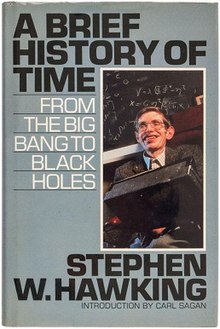
Stephen Hawking was born on January 8, 1942, in Oxford, England. At an early age, Hawking showed a passion for science and the sky. At age 21, while studying cosmology at the University of Cambridge, he was diagnosed with Amyotrophic Lateral Sclerosis. Despite his debilitating illness, he has done ground-breaking work in physics and cosmology, and his several books have helped to make science accessible to everyone.
and
A Brief History of Time attempts to explain a range of subjects in cosmology, including the Big Bang, black holes and light cones, to the non-specialist reader. Its main goal is to give an overview of the subject but, unusual for a popular science book, it also attempts to explain some complex mathematics. The 1996 edition of the book and subsequent editions discuss the possibility of time travel and wormholes and explore the possibility of having a universe without a quantum singularity at the beginning of time.
The author notes that an editor warned him that for every equation in the book the readership would be halved, hence it includes only a single equation: E = mc2......................................
5)
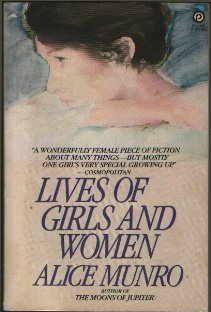
The only novel from Alice Munro-award-winning author of The Love of a Good Woman--is an insightful, honest book, "autobiographical in form but not in fact," that chronicles a young girl's growing up in rural Ontario in the 1940's.



No comments:
Post a Comment