Syria and the Selfishness of the West...They ruin people in Ukraine, in Iraq, in Afghanistan, in Syria...and their GREED has not limits...
The radical group ISIS ( Islamic State in Iraq and Syria) emerged last year as a major power in opposition-controlled parts of Syria. It is accused of the same kind of atrocities as the Syrian regime it fights.
There is a video that emerged few days ago and CNN has it of executions and kidnappings by radical Islamist opposed to the Syrian regime.
These are the Islamist who have also beheaded and mutilated Syrian Christians and have eaten their organs...and these are the people that "civilized " North America and Western Europe are supporting and providing arms. These cannibals are supported by the Turkish regime and Saudi Arabia.
It is depressing and disgusting...
The Western economies are in decline...The ONLY way they may halt their decline is by SELLING ARMS and propagating wars...
The "civilized West" will deal even with the most horrendous of groups...who have eaten the organs of Christian so as they will go to heaven...
***
The video clip that I referred to lasts a mere 35 seconds. I watched it...It is too disturbing and I do not want to contaminate the blog and disgust the reader. But,
It's night.
Six men, illuminated by a flashlight, are sitting with their hands tied behind their backs and blindfolded.
More men huddle behind them in the dark.
In front of them is a pit, apparently freshly dug, and on the other side of the pit sits another man similarly bound and blindfolded.
Two seconds into the clip, someone says, "Jahiz?" "Ready?"
At three seconds a man extends his right arm into the light, holding a pistol.
At six seconds the first shot is fired into the back of the first man's head. The man with the pistol moves decisively, without hesitation, shooting one after the other in the back of the head.
It would appear he has done this before many times. he is a professional assassin...
Eleven seconds into the video clip, you can hear what sounds like open faucets.But, it's the sound of blood gushing from the head wounds. And the gushing sound gets louder and louder.
Twenty-six seconds after the first shot is fired, a total of 14 men -- some of whom appear to be teenagers -- are dead or dying, some slumping into the pit.
This video clip was one of a variety recently that CNN has obtained from Syrian activists. They document atrocities committed not by the regime of President Bashar al-Assad, but rather by members of the Islamic State in Iraq and Syria, known as ISIS, which emerged last year as a major power in opposition-controlled parts of northern Syria.
In the areas controlled by ISIS, public floggings and executions have become commonplace. Most recently ISIS has battled other opposition groups in fighting that has left well over 2,000 people dead.
Even Al Qaeda's leader, Ayman Al-Zawahiri, has demanded ISIS leave Syria.
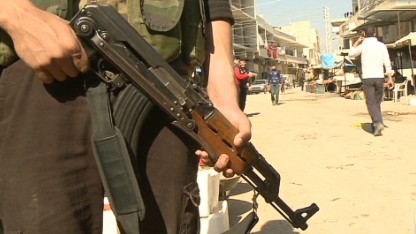
ISIS, the radical Islamists, beheaded one of the top rebel commanders -- placing his head in that very spot -- in broad daylight when the market was packed with people as a warning: anyone who dared oppose them would have the same fate.
|
.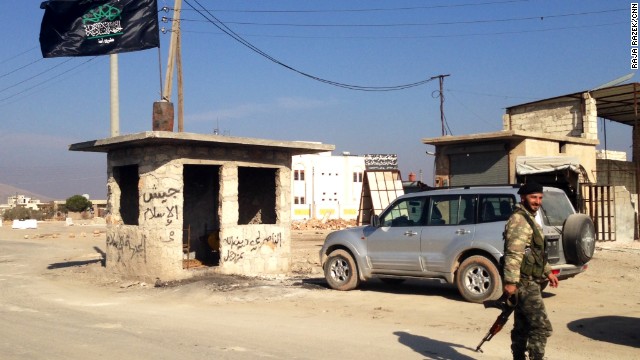
The writing on the wall translates "Soldiers of Islam"and "Islam" means PEACE...
Soldiers and Peace an oxymoron pairs...as it was when the Crusaders were launched...
We cannot have peace by fighting
Shakespeare wrote long time ago, "Blood begets blood"....Shakespeare was an excellent writer and a good mathematician without numbers...Blood can never be equal to peace...
Listen to him.
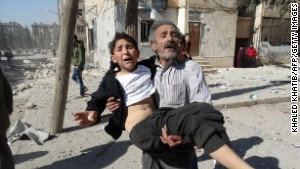
The kids are injured and Christians mutilated by the arms that the West and U.S. of A. have provided to ISIS and other anti regime groupings...in Syria.
I asked one of my former students, now a friend, if I should post the article below and the response was positive. I thank for the advice...and i will print it here...
I read the post you want to put on the blog
and I do not see why anyone should or would take that in the wrong way.
I did not take that in a personal way. I like the few paragraphs of analysis and explanation near the end of the article, it furthermore explains the purpose which is clear and should not cause people to interpret it in an unintended way. Regardless of religion or race, in the end we are all humans and there are many who are being mistreated. |
I hope more of you get involved into the blog and make it a meeting place of ideas.
It is sad that neighbours who have lived together for decades turn against their neighbours...Poles and Jews, Turkish genocidal drive against the Armenians...Syrians against Syrians...
My hope is that the new generation will be different...
Just a hope...
I always will imagine a world in peace with itself and all humankind living in prosperity and harmony...
H.K.
NEIGHBORS WHO LOVE… NEIGHBORS WHO KILL
In 2001 Tomasz Gross published a book called "Neighbors" in Poland,
wherein he revealed that in 1941 a horrendous mass-murder was committed
against 1500 Jews by their Polish neighbors. The place was in Jedwabne,
a small community in northeastern Poland. The massacre was not entirely
unheard of, but the country's official history attributed the murder
to the Nazi German occupiers.
The revelation came as a shock to many, and shook the foundations
of the Polish self-image as a victim of Nazism. Soon came to light
several similar crimes, and what is curious is that the scenario
had always been the same. Gross reveals the pattern, the Red Army is
retreating, the Germans enter the country and pogroms against Jews
are unleashed. The initiative is almost always taken by the Polish
and the pretext for murder is collaboration with the Soviets, and
there seems to have been no significant German involvement.
As if this was not enough, a second shock hit Poland and Polish society
in the form of the debate that followed the revelations. Above all,
rightist nationalist movements and the Catholic Church tried to deny
the crimes or trivialize them, since they could not rationalize
them with reference to the old anti-Semitic argument about Jewish
Communism. The debate divided the country into two irreconcilable
camps.
Soon, the book moved to the stage. Tadeusz Slobodzianek's play about
the same issue, titled "Our Class- History in XIV lessons". The play
has been staged since then with great success in London, the U.S.,
Hungary, Spain, Brazil, Czech Republic, Canada, Lithuania, Japan,
Scandinavia, and, of course, Poland.
The opening scene is set in a faded local restaurant, decorated in
poor taste, an awkward attempt to reclaim an elegance long lost,
bearing an unmistakable air of sadness and disarray. The right place
for a typical class reunion.
The class consists of ten students, five Catholic and five Jewish
Poles. All were born between 1918 and 1920, the time of independent
Poland's rebirth after 100 years of partition. The destiny of each
and every one mirrors the history of their country. It starts in the
interwar period. Anti-Semitism is emerging. Antipathy towards Jews
lies just below the surface, and occasionally is expressed in broad
daylight. Then comes the Soviet occupation in 1939,something which
many Jews regarded as a better alternative than the Nazis, a notion
that was definitely not shared by Poles.
"Our Class" is an exceptional play that promotes debate on issues of
morality and conscience, of evil, virtue, and guilt. It highlights
the difference between political ideologies and religion, and here
we encounter many examples of man's proclivity for destruction in a
time when humanity is replaced by cruelty.
Why bring up Tadeusz Slobodzianek now? The refugees, destruction,
and cruelty we are witnessing today in Syria, reminds me of
"Neighbors"--The news is flooded with Syrian refugee children drowned
in the Mediterranean, and only a few react.
Ancient cities-- Damascus, Aleppo, Tadmur-- are all in ruins. Neighbors
are butchering neighbors, a familiar scenario that we have been
witnessing for the last two decades, first in Iraq, and now in Syria.
Of course I am paralyzed. What is to be done? I keep on trying to
figure out what went wrong with people.
How can neighbors-- who greeted one another every morning with
wishes of "light" in the day, sharing "salt and bread", courteous and
well-mannered-- end up killing neighbors? Must we always be reminded
of what people are capable of doing?
What is it that makes our civilization fall through the cracks?
The play "Our Class" carries me back to my ancestors, to my
grandparents, and the sudden chaos that engulfed their placid lives.
Again and again, I try to understand why and how my grandma's neighbour
Elif and her husband Murad turned out to be bloodthirsty vampires?
In a small, idyllic, village, locals driven by self-interest,
vindictive and spiteful, commit the most horrible crimes in the name
of an ideology or religion. They gather the Jews inside a barn, (the
Armenians inside the church) and set it on fire. They watch it as
though watching fireworks. People who previously lived together and
were neighbors suddenly are turned into executioners and degenerate
into a lawlessness of the wicked sort. Afterwards, the violence
is blamed on others-- other people, other things.
The story is frighteningly similar, the Polish Jews' and Armenians',
the Poles' and Turks'.
And then I think about the children, ours and theirs. What do we talk
about in our school classes today? Sustainable lifestyles, climate
issues are in the foreground for our kids at school. We educate
them about creating a sustainable society. But sustainability is
not just about ecology. Sustainability is about values that keep our
civilization strong and going.
And Tadeusz Slobodzianek's work "Our Class" is a great source that
should be included in our school classes.
It's true that the play is set in World War II and the time that
preceded the war. But it is also a good instrument to illustrate the
pattern of events of our own times, and maybe, even the world that
awaits our children and grandchildren. The political turmoil around
the world-- the recent developments in the Middle East, in Syria,
in Iraq, in Kenya-- clearly tells us we need guidance.
We all know that morality and conscience, virtue and evil, are
complicated issues. That does not stop us from discussing these tough
issues. However, what is rarely debated is how to deal with these
questions today, in our own time, when we lack common standards,
a moral compass, grounds for consensus. In the absence of a guiding
compass, respect for human dignity is subordinated to more short-term
goals-- a political explanation, a temporary or trendy solution.
I listen to the news and watch mothers crying, for children swallowed
by the waters. The lump in my throat is never far away. It is deeply
shocking. The fate of all Christians in the Middle East is scary.
Where are we headed?
Yet I am also aware that people around the globe are exhausted with
the news and have no appetite to spend time and energy to understand
the forces that cause a person to completely abandon her decent human
values and suppress compassion. We refuse to listen even when the
murderers boast of their abuse and crack jokes about the horrors they
committed, or make a musical out of the mass murder. Have you seen
"The Act of Killing" by the Canadian Joshua Oppenheimer? See it. You
In 2001 Tomasz Gross published a book called "Neighbors" in Poland,
wherein he revealed that in 1941 a horrendous mass-murder was committed
against 1500 Jews by their Polish neighbors. The place was in Jedwabne,
a small community in northeastern Poland. The massacre was not entirely
unheard of, but the country's official history attributed the murder
to the Nazi German occupiers.
The revelation came as a shock to many, and shook the foundations
of the Polish self-image as a victim of Nazism. Soon came to light
several similar crimes, and what is curious is that the scenario
had always been the same. Gross reveals the pattern, the Red Army is
retreating, the Germans enter the country and pogroms against Jews
are unleashed. The initiative is almost always taken by the Polish
and the pretext for murder is collaboration with the Soviets, and
there seems to have been no significant German involvement.
As if this was not enough, a second shock hit Poland and Polish society
in the form of the debate that followed the revelations. Above all,
rightist nationalist movements and the Catholic Church tried to deny
the crimes or trivialize them, since they could not rationalize
them with reference to the old anti-Semitic argument about Jewish
Communism. The debate divided the country into two irreconcilable
camps.
Soon, the book moved to the stage. Tadeusz Slobodzianek's play about
the same issue, titled "Our Class- History in XIV lessons". The play
has been staged since then with great success in London, the U.S.,
Hungary, Spain, Brazil, Czech Republic, Canada, Lithuania, Japan,
Scandinavia, and, of course, Poland.
The opening scene is set in a faded local restaurant, decorated in
poor taste, an awkward attempt to reclaim an elegance long lost,
bearing an unmistakable air of sadness and disarray. The right place
for a typical class reunion.
The class consists of ten students, five Catholic and five Jewish
Poles. All were born between 1918 and 1920, the time of independent
Poland's rebirth after 100 years of partition. The destiny of each
and every one mirrors the history of their country. It starts in the
interwar period. Anti-Semitism is emerging. Antipathy towards Jews
lies just below the surface, and occasionally is expressed in broad
daylight. Then comes the Soviet occupation in 1939,something which
many Jews regarded as a better alternative than the Nazis, a notion
that was definitely not shared by Poles.
"Our Class" is an exceptional play that promotes debate on issues of
morality and conscience, of evil, virtue, and guilt. It highlights
the difference between political ideologies and religion, and here
we encounter many examples of man's proclivity for destruction in a
time when humanity is replaced by cruelty.
Why bring up Tadeusz Slobodzianek now? The refugees, destruction,
and cruelty we are witnessing today in Syria, reminds me of
"Neighbors"--The news is flooded with Syrian refugee children drowned
in the Mediterranean, and only a few react.
Ancient cities-- Damascus, Aleppo, Tadmur-- are all in ruins. Neighbors
are butchering neighbors, a familiar scenario that we have been
witnessing for the last two decades, first in Iraq, and now in Syria.
Of course I am paralyzed. What is to be done? I keep on trying to
figure out what went wrong with people.
How can neighbors-- who greeted one another every morning with
wishes of "light" in the day, sharing "salt and bread", courteous and
well-mannered-- end up killing neighbors? Must we always be reminded
of what people are capable of doing?
What is it that makes our civilization fall through the cracks?
The play "Our Class" carries me back to my ancestors, to my
grandparents, and the sudden chaos that engulfed their placid lives.
Again and again, I try to understand why and how my grandma's neighbour
Elif and her husband Murad turned out to be bloodthirsty vampires?
In a small, idyllic, village, locals driven by self-interest,
vindictive and spiteful, commit the most horrible crimes in the name
of an ideology or religion. They gather the Jews inside a barn, (the
Armenians inside the church) and set it on fire. They watch it as
though watching fireworks. People who previously lived together and
were neighbors suddenly are turned into executioners and degenerate
into a lawlessness of the wicked sort. Afterwards, the violence
is blamed on others-- other people, other things.
The story is frighteningly similar, the Polish Jews' and Armenians',
the Poles' and Turks'.
And then I think about the children, ours and theirs. What do we talk
about in our school classes today? Sustainable lifestyles, climate
issues are in the foreground for our kids at school. We educate
them about creating a sustainable society. But sustainability is
not just about ecology. Sustainability is about values that keep our
civilization strong and going.
And Tadeusz Slobodzianek's work "Our Class" is a great source that
should be included in our school classes.
It's true that the play is set in World War II and the time that
preceded the war. But it is also a good instrument to illustrate the
pattern of events of our own times, and maybe, even the world that
awaits our children and grandchildren. The political turmoil around
the world-- the recent developments in the Middle East, in Syria,
in Iraq, in Kenya-- clearly tells us we need guidance.
We all know that morality and conscience, virtue and evil, are
complicated issues. That does not stop us from discussing these tough
issues. However, what is rarely debated is how to deal with these
questions today, in our own time, when we lack common standards,
a moral compass, grounds for consensus. In the absence of a guiding
compass, respect for human dignity is subordinated to more short-term
goals-- a political explanation, a temporary or trendy solution.
I listen to the news and watch mothers crying, for children swallowed
by the waters. The lump in my throat is never far away. It is deeply
shocking. The fate of all Christians in the Middle East is scary.
Where are we headed?
Yet I am also aware that people around the globe are exhausted with
the news and have no appetite to spend time and energy to understand
the forces that cause a person to completely abandon her decent human
values and suppress compassion. We refuse to listen even when the
murderers boast of their abuse and crack jokes about the horrors they
committed, or make a musical out of the mass murder. Have you seen
"The Act of Killing" by the Canadian Joshua Oppenheimer? See it. You
will understand what it means to illustrate murder and then dance
in ecstasy.
Yes, I am convinced that we are surrounded by a culture of silence,
a silence reinforced by the ghosts of mutual blackmail. We live
in blessed ignorance. We sing folk songs, recite poems, watch
action-packed movies. Meanwhile, what is happening around is
not a bit comical. We are all anti-heroes with an air of forced
self-righteousness. Or, we avoid people, and watch channels where no
human beings are shown.
The world around us is a theater that upsets and hurts. But remember
that history is always a part of the present. Remember that there
were people who loved, killed, tortured, burned, buried, repented,
excused themselves, and died. However the violence, the killings,
and those who perished, the dead bodies are always left at the scene,
no one ever disappears. What is going on around us today makes for
a show so dense, so powerful, that it seems we are seated in the
theater on the brink of one of history's greatest black holes.
in ecstasy.
Yes, I am convinced that we are surrounded by a culture of silence,
a silence reinforced by the ghosts of mutual blackmail. We live
in blessed ignorance. We sing folk songs, recite poems, watch
action-packed movies. Meanwhile, what is happening around is
not a bit comical. We are all anti-heroes with an air of forced
self-righteousness. Or, we avoid people, and watch channels where no
human beings are shown.
The world around us is a theater that upsets and hurts. But remember
that history is always a part of the present. Remember that there
were people who loved, killed, tortured, burned, buried, repented,
excused themselves, and died. However the violence, the killings,
and those who perished, the dead bodies are always left at the scene,
no one ever disappears. What is going on around us today makes for
a show so dense, so powerful, that it seems we are seated in the
theater on the brink of one of history's greatest black holes.
And the hole is getting larger and larger...But...
***
In this Black History month...I have a dream too...of a world in peace with itself and all people loving each other and living in harmony...The students, the new kids on the block have the potential and educational institutions, teachers should motivate them to surge forward...to fly high and higher and insist that there are no limits...
H.K.

No comments:
Post a Comment